
Naming a daughter is terrifying. I say this as a man who stared at a blank birth certificate for an hour while my wife slept off the exhaustion of labor. The nurses were hovering, the clock was ticking, and I felt the weight of the decision pressing down on my chest. You want something strong, right? Something beautiful. But you also don’t want to saddle a tiny human with a moniker that sounds like a character from a bad fantasy novel.
That’s where royal girl names save the day. They hit that elusive sweet spot between heavy historical weight and modern usability. They command respect without demanding a curtsy—though, let’s be honest, you might get one anyway if you pick the right one.
Whether you are hunting for a name that screams “future CEO” or one that whispers of vintage elegance, history’s monarchs have already done the focus grouping for you. These names have survived wars, revolutions, beheadings, and changing fashions. If they can survive the War of the Roses, they can survive middle school.
Also Read: Gothic Girl Names and Best Names for Girls Born in Autumn
Key Takeaways
- Historical Depth: Royal names carry centuries of baggage—the good kind. They provide instant stability and a sense of tradition.
- Versatility: Names like Elizabeth or Victoria offer cute, approachable nicknames for the playground while remaining iron-clad professional for the boardroom.
- Global Inspiration: Don’t just look at London. Spain, Jordan, Japan, and ancient empires offer incredible, unique options that still feel regal.
- Meaning Matters: Beyond the sound, many of these names literally translate to “queen,” “princess,” or “noble,” giving your daughter a secret title.
Why do we gravitate toward regal names for our daughters?
Let’s be real for a second. Every dad looks at his little girl and sees a princess. I know I did. It’s a cliché because it’s true. But giving her a name with royal roots isn’t just about playing dress-up in tulle skirts. It is about legacy. We want our daughters to walk into a room and own it. We want them to have a name that doesn’t shrink.
I remember debating names with my wife late into the third trimester. I wanted something cool, edgy, maybe a bit rock-and-roll; she wanted something classic and timeless. We fought about it over takeout Thai food more times than I care to admit. Eventually, we realized that royal girl names were the perfect ceasefire. They are familiar enough that no one asks, “Wait, how do you spell that?” but they carry a dignity that the “trendy” names of the year often lack. When you name a girl Catherine or Eleanor, you are handing her a history of powerful women who ran empires, negotiated treaties, and sometimes led armies. That is a pretty solid gift to give a kid on day one.
What are the quintessential British classics?
You cannot discuss royalty without starting in London. The British monarchy has maintained a fairly tight rotation of names for a thousand years. This actually works in your favor if you want something timeless that won’t date your child to a specific decade.
Elizabeth The heavyweight champion of royal names. Queen Elizabeth I defined an era of exploration and art, and Queen Elizabeth II defined a century of duty. It means “pledged to God.” Plus, the nickname potential is endless: Liz, Beth, Ellie, Libby, Betsy. You can change the nickname as she grows up.
Victoria Queen Victoria ruled for 63 years and gave her name to an entire era of history. The name literally means “victory.” It’s strong, feminine, and undeniably grand. I knew a Victoria in college who went by “Vic”—she was the toughest rugby player I ever met. The name fits grit just as well as it fits lace.
Charlotte Thanks to the current young Princess Charlotte, this name has surged back into the spotlight. It’s the feminine form of Charles, meaning “free man.” It feels posh but friendly, avoiding the stuffiness of some older royal names.
Diana The “People’s Princess” changed the monarchy forever. The name has Roman mythological roots (the goddess of the hunt) and evokes kindness, style, and glamour. It feels soft, but there is steel underneath it.
Alice Queen Victoria’s second daughter was famous for her compassion and intellect. It was a massive name in the 19th century and has made a huge comeback. It means “noble.” It’s short, sweet, and impossible to mess up.
Beatrice Princess Beatrice of York carries this vintage gem. It means “she who brings happiness.” It’s quirky, vintage, and distinctly royal without being as common as Elizabeth.
Anne The Princess Royal, known for her insane work ethic and no-nonsense attitude, carries this name. It’s simple, Hebrew for “grace,” and packs a lot of punch in one syllable. It’s the little black dress of names—classic and goes with everything.
Mary England has seen two Queen Marys (one a bit bloodier than the other). It is the ultimate traditional name, often overlooked today in favor of flashier options, which actually makes it a unique choice for a modern baby.
Can we find elegance in Continental Europe?
If you cross the English Channel, the names get a little more lyrical. European courts in France, Spain, and Russia offer some of the most romantic royal girl names in history. These names often have a bit more flair and drama.
I have a buddy, a total guys’ guy, who married a woman from Spain. They named their daughter Leonor, after the current heir to the Spanish throne. I remember thinking, “Wow, that sounds expensive.” It sounds so much more sophisticated than just “Eleanor,” doesn’t it? It rolls off the tongue like a song.
Isabella Queen Isabella of Castile was a powerhouse who unified Spain. The name is incredibly popular now, but for good reason. It has flair. It demands attention.
Antoinette Associated with the tragic French Queen Marie Antoinette. It’s elaborate and fancy. Maybe a bold choice for a first name given the history, but it makes a stunning middle name if you want to add some frills.
Anastasia The youngest daughter of the last Tsar of Russia. The name means “resurrection.” It is grand, dramatic, and comes with the cute nickname “Ana” or “Stasya.” Just be prepared for people to sing the cartoon movie song to her.
Wilhelmina The name of the long-reigning Queen of the Netherlands. It is the feminine form of William. With “Billie” and “Mina” as nicknames, it is surprisingly trendy right now. It bridges the gap between old-world clunky and new-world cool.
Grace Grace Kelly went from Hollywood royalty to actual royalty as Princess Grace of Monaco. It is a virtue name that never goes out of style. It implies elegance before the kid even learns to walk.
Amalia The heir to the Dutch throne is Catharina-Amalia. Amalia means “work,” but in the sense of industry and effort. It sounds gentle but has a strong backbone.
What about the warrior queens of the ancient world?
Sometimes you don’t want a princess name; you want a conqueror name. History is full of women who didn’t just sit on thrones and wave; they led armies, built empires, and terrified Rome.
Cleopatra The last Pharaoh of Egypt. While “Cleo” is a super cute, spunky name for a modern girl, the full Cleopatra is a statement. It takes confidence to pull this off, but if she’s anything like my daughter, she’ll have plenty of that.
Boudicca The Celtic queen who led a massive uprising against the Roman Empire. Maybe a bit intense for a birth certificate (and hard to spell for a kindergartner), but it’s an undeniable symbol of strength.
Zenobia Queen of the Palmyrene Empire who challenged Rome. This is an edgy, “Z” name that fits right in with modern trends like Zoe and Zelda, but it has serious history cred.
Dido The legendary founder and first Queen of Carthage. It’s short, sharp, and rare. It sounds modern, even though it’s thousands of years old.
Artemisia A queen of Halicarnassus who commanded ships in battle. It’s also associated with the goddess of the hunt. It’s a mouthful, but “Artie” is a cool nickname.
Which names actually mean “Queen” or “Princess”?
Maybe you want to be a little more literal. There are dozens of beautiful names from around the world that translate directly to a royal title. This is a subtle way to give your daughter a regal title without literally naming her “Queen” (which, let’s be honest, is a bit much).
Sarah You probably didn’t know this biblical classic means “princess” in Hebrew. It’s common, yes, but its meaning is top-tier. It’s the stealth bomber of royal names.
Raina (or Reina) The Spanish word for “queen.” It’s simple, multicultural, and beautiful. It works in almost any language.
Malika Arabic for “queen.” It has a lovely rhythm to it and sounds incredibly elegant.
Juno The Queen of the Heavens in Roman mythology. It sounds modern and cool, perfect for a creative family who wants something off the beaten path.
Rhiannon A Welsh name meaning “great queen.” It has a mystical, folklore vibe (and yes, a great Fleetwood Mac song attached to it, which is a bonus).
How does pop culture shape our view of royalty?
We can’t pretend Disney and HBO haven’t influenced us. Fictional royals often have the best names because writers pick them to sound specifically majestic. They are engineered to sound good.
I will admit, I fought hard for Leia when our daughter was born. My wife vetoed it immediately—something about not wanting her to have “Star Wars buns” in every baby photo—but the name means “weary” or “mistress” and feels undeniably royal to anyone who grew up in the 80s. I still think I was right, but you pick your battles.
Ariel Before the mermaid, this was a Hebrew name meaning “Lion of God.” But now? It’s pure princess. If you use it, just accept the mermaid jokes will happen.
Elsa Frozen changed the landscape for this name. Originally a diminutive of Elisabeth, now it stands on its own as a queenly title. It’s distinct and icy cool.
Khaleesi Okay, a word of advice from one dad to another: Be careful with this one. It skyrocketed during Game of Thrones, but names tied that tightly to a single character can age poorly (especially given how that show ended). Maybe stick to Daenerys or Dany if you must.
Tiana The hardworking princess from The Princess and the Frog. It’s short, sweet, and modern. It sounds ambitious.
Aurora Sleeping Beauty’s real name. It means “dawn.” It has been climbing the charts because it sounds magical but is still a real Latin word.
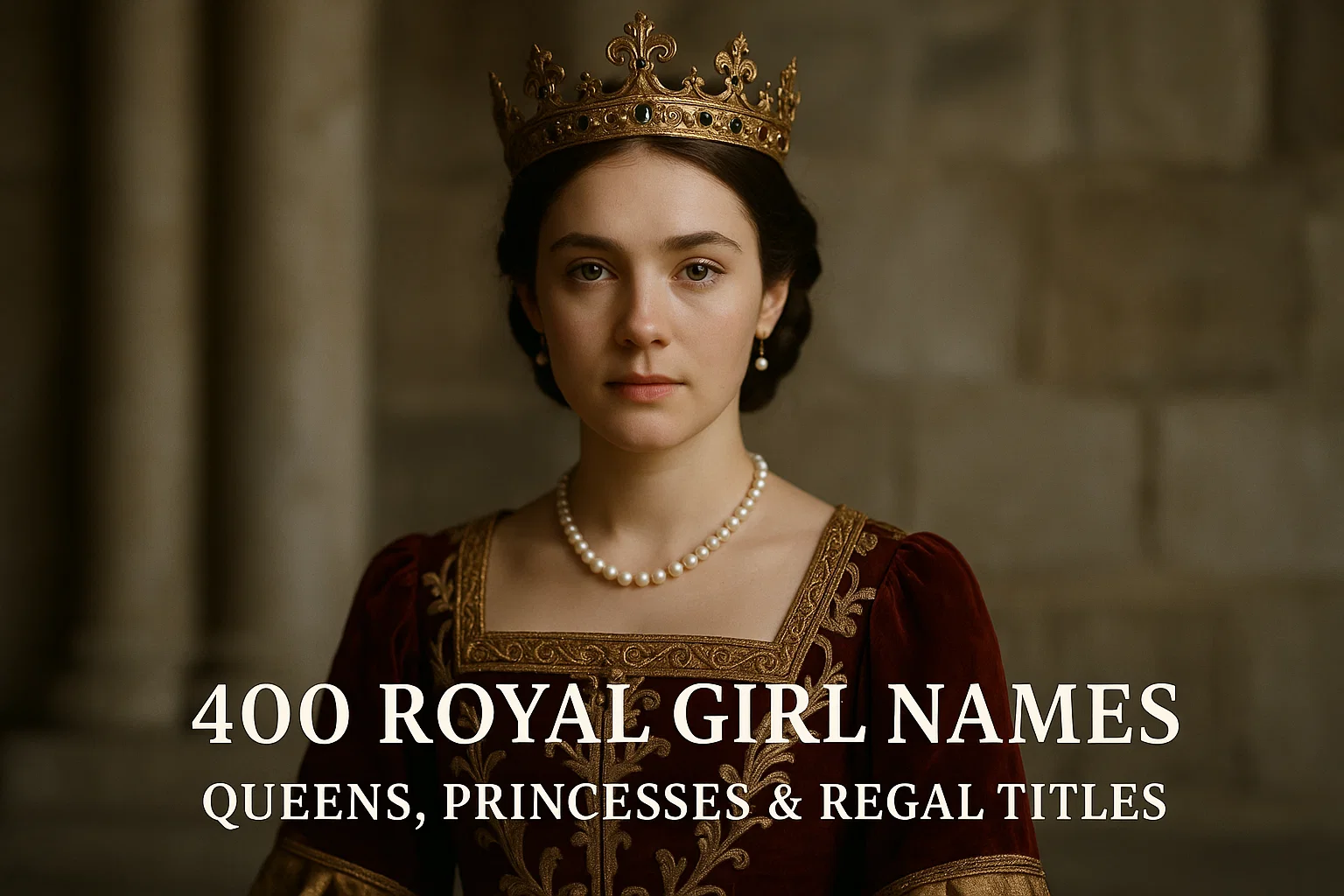
The Massive List: 400 Royal Names by Category
Here is the deep dive. I’ve broken these down so you can find the specific “flavor” of royalty you are looking for.
The British & English Court
These are safe, traditional, and universally recognized. They work on a baby and they work on a Supreme Court Justice.
- Elizabeth – Hebrew for “pledged to God.” The ultimate royal standard.
- Victoria – Latin for “victory.” A name that defined an entire century.
- Anne – Hebrew for “grace.” Simple, strong, and timeless.
- Mary – Hebrew/Egyptian, “beloved” or “bitter.” A classic Queen name.
- Catherine – Greek for “pure.” Borne by three of Henry VIII’s wives and the current Princess of Wales.
- Charlotte – French for “free man.” The feminine form of Charles.
- Diana – Latin, “divine.” The goddess of the hunt and moon.
- Camilla – Latin, “young ceremonial attendant.” Current Queen Consort.
- Sophie – Greek for “wisdom.” Elegant and soft.
- Beatrice – Latin, “she who brings happiness.” A joyful vintage choice.
- Eugenie – Greek, “well-born” or “noble.”
- Louise – German/French, “renowned warrior.”
- Margaret – Greek, “pearl.” A royal staple for centuries.
- Augusta – Latin, “majestic” or “venerable.”
- Adelaide – German, “noble natured.”
- Matilda – German, “battle-mighty.” A warrior queen name.
- Eleanor – Provençal, meaning uncertain but associated with “light.”
- Jane – Hebrew, “God is gracious.” Brief queen (Lady Jane Grey).
- Philippa – Greek, “lover of horses.”
- Emma – German, “universal” or “whole.” Queen Emma of Normandy.
- Alexandra – Greek, “defender of mankind.”
- Caroline – French, feminine of Charles (“free man”).
- Sophia – Greek for “wisdom.”
- Helena – Greek, “shining light.”
- Alice – German, “noble.”
- Maud – A variation of Matilda (“battle-mighty”).
- Cecily – Latin, “blind.” Mother of kings (Cecily Neville).
- Joan – Hebrew, “God is gracious.”
- Isabella – Hebrew, “pledged to God” (Spanish variation).
- Henrietta – German, “estate ruler.”
- Agatha – Greek, “good.” William the Conqueror’s daughter.
- Edith – English, “prosperous in war.”
- Sarah – Hebrew, “princess.”
- Frances – Latin, “from France” or “free one.”
- Zara – Arabic/Hebrew, “blooming flower” or “princess.”
- Savannah – Spanish, “treeless plain.” Queen Elizabeth’s great-granddaughter.
- Isla – Scottish, “island.”
- Mia – Latin/Scandinavian, “mine” or “bitter.”
- Lena – Greek/German, “light” or “alluring.”
- Lilibet – The childhood nickname of Queen Elizabeth II.
- Rose – Latin, the flower. A royal favorite middle name.
- Marina – Latin, “of the sea.”
- Katherine – Greek, “pure.” (Alternate spelling).
- Georgiana – Greek, “farmer.” Feminine of George.
- Amelia – German, “work.”
- Dorothea – Greek, “gift of God.”
- Charlotte – French, “free man.” (Repeated for emphasis on popularity).
- Alexandrina – Variation of Alexandra, Queen Victoria’s first name.
- Gwenllian – Welsh, “white/fair flood.” A true Welsh warrior princess.
- Boudicca – Celtic, “victory.” The rebel queen.
The French Court (Chic & Sophisticated)
French royal names have a certain je ne sais quoi. They often sound softer and more flowery than their English cousins.
- Marie – French form of Mary (“star of the sea”).
- Antoinette – Latin, “priceless one.”
- Claude – Latin, “lame” (don’t let the meaning fool you, it was a Queen’s name).
- Eugénie – French form of Eugenia (“well-born”).
- Josephine – Hebrew, “Jehovah increases.” Napoleon’s Empress.
- Adélaïde – French form of Adelaide (“noble type”).
- Clotilde – German, “famous in battle.”
- Berthe – German, “bright” or “glorious.”
- Blanche – French, “white” or “fair.”
- Constance – Latin, “steadfastness.”
- Eleanor (Alienor) – Greek/French, “light.”
- Giselle – German, “pledge.”
- Hortense – Latin, “gardener.”
- Isabelle – French variation of Elizabeth (“pledged to God”).
- Jeanne – French form of Joan (“God is gracious”).
- Louise – French, “renowned warrior.”
- Madeleine – Hebrew, “woman from Magdala.”
- Marguerite – French for “daisy” or “pearl.”
- Mathilde – French form of Matilda (“mighty in battle”).
- Renée – French, “reborn.”
- Solange – Latin, “solemn.”
- Thérèse – Greek, “to harvest.”
- Valentine – Latin, “strength/health.”
- Yolande – Greek, “violet flower.”
- Amélie – French form of Amelia (“industrious”).
- Catherine – Greek, “pure” (De Medici fame).
- Diane – Latin, “divine” (Diane de Poitiers).
- Elisabeth – French spelling of Elizabeth.
- Henriette – French, “home ruler.”
- Marianne – Combination of Marie and Anne. Symbol of France.
- Charlotte – French, “petite” or “free.”
- Victoire – French for “victory.”
- Sophie – Greek, “wisdom.”
- Hélène – French form of Helen (“light”).
- Françoise – French, “free one.”
- Anne – Hebrew, “grace” (Anne of Brittany).
- Geneviève – Celtic/French, “tribe woman.” Patron saint of Paris.
- Olympe – Greek, “from Mount Olympus.”
- Eléonore – French variation of Eleanor.
- Gabrielle – Hebrew, “God is my strength.”
- Juliette – Latin, “youthful.”
- Camille – Latin, “perfect” or “young ceremonial student.”
- Margot – Diminutive of Marguerite (“pearl”).
- Simone – Hebrew, “hearkening.”
- Sylvie – Latin, “from the forest.”
- Veronique – Latin, “true image.”
- Colette – Greek, “people of victory.”
- Delphine – Greek, “dolphin” or “of Delphi.”
- Eloise – French/German, “healthy” or “wide.”
- Fleur – French, “flower.”
Spanish & Portuguese Royalty (Passion & Grace)
These names often end in ‘a’, giving them a rhythmic, feminine sound. They are full of life.
- Isabella – Hebrew/Italian, “pledged to God.”
- Isabel – Spanish form of Elizabeth.
- Sofia – Greek, “wisdom.”
- Leonor – Greek/Provençal, “light.”
- Elena – Spanish form of Helen (“shining light”).
- Cristina – Latin, “follower of Christ.”
- Maria – Latin/Hebrew, “bitter” or “beloved.”
- Letizia – Latin, “joy” or “gladness.”
- Juana – Spanish form of Jane (“God is gracious”).
- Catalina – Spanish form of Catherine (“pure”).
- Teresa – Greek, “to harvest.”
- Urraca – Spanish, “magpie.” A strong medieval queen.
- Berengaria – German, “bear-spear.”
- Blanca – Spanish, “white.”
- Mafalda – Portuguese form of Matilda (“battle-mighty”).
- Amelie – German, “work.”
- Francisca – Spanish, “free one.”
- Ines – Spanish form of Agnes (“pure/holy”).
- Luisa – Spanish feminine of Louis (“famous warrior”).
- Mariana – Combination of Maria and Ana.
- Mercedes – Spanish, “mercies.”
- Pilar – Spanish, “pillar.”
- Violante – Latin, “violet.”
- Ximena – Spanish, “hearkening.”
- Sancha – Spanish, “holy.”
- Constanza – Spanish, “constant.”
- Elvira – German/Spanish, “truth.”
- Beatriz – Spanish form of Beatrice (“bringer of joy”).
- Eulalia – Greek, “sweetly speaking.”
- Fernanda – German, “bold voyager.”
- Gabriela – Hebrew, “God is my strength.”
- Leonora – Variation of Eleanor (“light”).
- Lucia – Latin, “light.”
- Margarita – Spanish for “daisy” or “pearl.”
- Patricia – Latin, “noble.”
- Ramona – German/Spanish, “wise protector.”
- Rocío – Spanish, “dew.”
- Valentina – Latin, “strong/healthy.”
- Victoria – Latin, “victory.”
- Zita – Greek/Italian, “seeker.” Last Empress of Austria.
- Carlota – Spanish form of Charlotte (“free man”).
- Dolores – Spanish, “sorrows” (Lady of Sorrows).
- Esperanza – Spanish, “hope.”
- Felicita – Latin, “happiness.”
- Gracia – Spanish, “grace.”
- Josefina – Spanish form of Josephine.
- Lola – Short for Dolores (“sorrows”).
- Manuela – Hebrew, “God is with us.”
- Paloma – Latin, “dove” (peace).
- Reina – Spanish, “queen.”
The Russian & Eastern European Aristocracy
If you want something dramatic and slightly exotic, look to the Romanovs and beyond. These names command a room.
- Anastasia – Greek, “resurrection.”
- Catherine (Ekaterina) – Greek, “pure.”
- Alexandra – Greek, “defender of mankind.”
- Olga – Old Norse/Russian, “holy.”
- Tatiana – Latin, “fairy queen” or Sabine clan name.
- Maria – Hebrew, “beloved.”
- Natalia – Latin, “Christmas Day.”
- Elena (Yelena) – Greek, “bright, shining light.”
- Sofia – Greek, “wisdom.”
- Xenia – Greek, “hospitality/stranger.”
- Irina – Greek, “peace.”
- Anna – Hebrew, “grace.”
- Elizaveta – Russian form of Elizabeth.
- Feodorovna – Russian patronymic, “daughter of Feodor.”
- Kira – Greek, “ruler.”
- Marina – Latin, “of the sea.”
- Nadia – Russian, “hope.”
- Vera – Russian, “faith.”
- Svetlana – Slavic, “light.”
- Ludmila – Slavic, “favor of the people.”
- Daria – Persian/Greek, “possessing goodness.”
- Galina – Greek, “calm.”
- Katerina – Variation of Catherine.
- Larisa – Greek, “citadel.”
- Mila – Slavic, “gracious” or “dear.”
- Nina – Georgian/Russian, “dreamer” or “grace.”
- Oksana – Ukrainian form of Xenia (“hospitality”).
- Polina – Latin, “little” or “humble.”
- Raisa – Greek, “rose” or Arabic “leader.”
- Sonya – Russian diminutive of Sofia (“wisdom”).
- Tamara – Hebrew, “palm tree.”
- Valentina – Latin, “strong.”
- Yulia – Russian form of Julia (“youthful”).
- Zoya – Greek/Russian, “life.”
- Alina – Slavic, “bright/beautiful.”
- Anoushka – Hebrew, “grace/favor.”
- Dominika – Latin, “of the Lord.”
- Ivana – Slavic, “God is gracious.”
- Jelena – Slavic form of Helen.
- Kalina – Slavic, “flower.”
- Lada – Slavic goddess of beauty.
- Milena – Slavic, “love, warmth, grace.”
- Nata – Short for Natalia.
- Olena – Ukrainian form of Helen.
- Petra – Greek, “rock.”
- Renata – Latin, “reborn.”
- Sabina – Latin, “Sabine woman.”
- Stanislava – Slavic, “glory of the camp.”
- Vada – German, “famous ruler.”
- Zaria – Slavic, “morning star/princess.”
Ancient & Mythological Queens
For parents who love history books and legends. These are for the bold.
- Cleopatra – Greek, “glory of the father.”
- Nefertiti – Egyptian, “the beautiful one has come.”
- Hatshepsut – Egyptian, “foremost of noble ladies.”
- Zenobia – Greek, “life of Zeus.”
- Boudicca – Celtic, “victory.”
- Artemisia – Greek, “gift of Artemis.”
- Dido – Phoenician, “wanderer.”
- Olympias – Greek, “from Olympus.”
- Berenice – Greek, “bringer of victory.”
- Arsinoe – Greek, “high mind.”
- Gorgo – Greek, “grim/dread.” Spartan Queen.
- Teuta – Illyrian, “queen/mistress of the people.”
- Mavia – Arabic, “water/essence of life.”
- Tomyris – Persian, “brave.”
- Amanirenas – Meroitic, “Amani (god) is her name.”
- Cartimandua – Celtic, “sleek pony.”
- Hypatia – Greek, “supreme.”
- Jezebel – Hebrew, “where is the prince?”
- Athaliah – Hebrew, “afflicted of the Lord.”
- Esther – Persian, “star.”
- Sheba – Hebrew, “promise.”
- Candace – Ethiopian title for “Queen Mother.”
- Helena – Greek, “shining light” (Troy).
- Penelope – Greek, “weaver.”
- Clytemnestra – Greek, “famed suitor.”
- Hecuba – Greek, “far off.”
- Andromeda – Greek, “ruler of men.”
- Ariadne – Greek, “most holy.”
- Cassiopeia – Greek, “she whose words excel.”
- Hippolyta – Greek, “freer of horses.”
- Penthesilea – Greek, “mourned by the people.”
- Medea – Greek, “cunning.”
- Semiramis – Assyrian, “lover of doves.”
- Guinevere – Welsh, “white phantom.”
- Morgana – Welsh, “sea circle.”
- Isolde – Welsh, “ice ruler.”
- Brunhild – German, “armored warrior.”
- Grimhild – German, “masked battle.”
- Gudrun – Norse, “god’s secret lore.”
- Signy – Norse, “new victory.”
Scandinavian & Northern Nobility
Cool, crisp, and effortlessly stylish. Perfect if you like modern minimalism.
- Astrid – Norse, “divinely beautiful.”
- Ingrid – Norse, “Ing’s beauty.”
- Margrethe – Danish form of Margaret (“pearl”).
- Sonja – Scandinavian form of Sofia (“wisdom”).
- Silvia – Latin, “from the woods.”
- Victoria – Latin, “victory.”
- Madeleine – French/Swedish, “of Magdala.”
- Estelle – Latin, “star.”
- Leonore – Variant of Eleanor (“light”).
- Märtha – Aramaic, “lady.”
- Ragnhild – Norse, “battle counsel.”
- Ulrika – German, “wolf ruler” or “power of the wolf.”
- Lovisa – Swedish form of Louise (“famous warrior”).
- Kristina – Latin, “follower of Christ.”
- Hedvig – German, “battle war.”
- Desirée – French, “desired.”
- Birgitta – Norse, “strength.”
- Christina – Latin, “follower of Christ.”
- Thyra – Norse, “Thor’s fight.”
- Dagmar – Norse, “day maid.”
- Ingeborg – Norse, “under the protection of Ing.”
- Benedikte – Latin, “blessed.”
- Anne-Marie – Combination of Grace and Bitter.
- Mette-Marit – Scandinavian combo name (“Pearl” + “Pearl”).
- Sofia – Greek, “wisdom.”
- Josephine – Hebrew, “Jehovah increases.”
- Athena – Greek, goddess of wisdom.
- Freya – Norse, “noble woman.”
- Sigrid – Norse, “beautiful victory.”
- Tuva – Norse, “beautiful” or “thunder.”
- Ebba – German, “strength of a boar.”
- Linnea – Swedish, “lime tree.”
- Saga – Norse, “seeing one” or “story.”
- Svea – Personification of Sweden.
- Wilma – German, “resolute protection.”
- Alva – Norse, “elf.”
- Elsa – German, “pledged to God.”
- Klara – Latin, “bright/clear.”
- Nellie – Latin, “light.”
- Vilde – Norse, “battle of elves.”
Asian & Middle Eastern Royalty
Names with deep meanings and beautiful sounds.
- Rania – Arabic, “delightful” or “content.”
- Noor – Arabic, “light.”
- Salma – Arabic, “peaceful.”
- Iman – Arabic, “faith.”
- Haya – Arabic, “life” or “humble.”
- Masako – Japanese, “proper child.”
- Aiko – Japanese, “child of love.”
- Mako – Japanese, “child of truth.”
- Kako – Japanese, “flower/rainbow.”
- Kiko – Japanese, “rejoicing child.”
- Michiko – Japanese, “child of beauty and wisdom.”
- Sirikit – Thai, “glory of the Kitiyakara.”
- Bajrakitiyabha – Thai, “diamond.”
- Jetsun – Tibetan, “venerable.”
- Ashi – Bhutanese title, “Lady.”
- Ameera – Arabic, “princess.”
- Deena – Arabic, “religion/creed.”
- Lalla – Berber title, “Lady.”
- Salma – Arabic, “safe.”
- Zaynab – Arabic, “fragrant flower.”
- Soraya – Persian, “jewel” or “Pleiades.”
- Farah – Arabic, “joy.”
- Nur – Arabic, “light.”
- Jahan – Persian, “world.”
- Mumtaz – Arabic, “distinguished.”
- Razia – Arabic, “content.” (Sultan Razia).
- Indira – Sanskrit, “beauty.”
- Gayatri – Sanskrit, “mother of Vedas.”
- Lakshmi – Sanskrit, “good sign/omen.”
- Sita – Sanskrit, “furrow.”
- Padmini – Sanskrit, “lotus.”
- Draupadi – Sanskrit, “daughter of Drupada.”
- Kunti – Sanskrit, “spear.”
- Damayanti – Sanskrit, “subduing.”
- Rukmini – Sanskrit, “adorned with gold.”
- Savitri – Sanskrit, “solar/sun.”
- Amira – Arabic, “princess.”
- Malika – Arabic, “queen.”
- Sultana – Arabic, “ruler.”
- Shahzadi – Persian, “daughter of the king.”
Names That Mean “Queen”, “Princess” or “Noble”
Literal translations for a hidden royal meaning.
- Regina – Latin for “Queen.”
- Reine – French for “Queen.”
- Reina – Spanish for “Queen.”
- Rhiannon – Welsh, “Great Queen.”
- Morrigan – Irish, “Phantom Queen.”
- Sarah – Hebrew, “Princess.”
- Sarai – Hebrew, “My Princess.”
- Sadie – Diminutive of Sarah (“Princess”).
- Sally – Diminutive of Sarah (“Princess”).
- Zara – Arabic, “Princess” or “Flower.”
- Adara – Arabic/Greek, “Noble.”
- Adela – German, “Noble.”
- Adelina – German, “Noble.”
- Alice – German, “Noble.”
- Alina – Slavic, “Noble/Bright.”
- Arwen – Welsh, “Noble Maiden.”
- Arya – Sanskrit, “Noble.”
- Audrey – English, “Noble Strength.”
- Brianna – Celtic, “High, Noble.”
- Daria – Persian, “Kingly/Wealthy.”
- Ethel – English, “Noble.”
- Freya – Norse, “Noble Woman.”
- Juno – Latin, “Queen of Heavens.”
- Kyra – Greek, “Throne/Lord.”
- Maude – German, “Battle Mighty.”
- Milcah – Hebrew, “Queen.”
- Mira – Latin, “Ruler/Peace.”
- Orla – Irish, “Golden Princess.”
- Patricia – Latin, “Noble.”
- Tiana – Greek/Russian, “Princess.”
Modern & Fictional Royals
Inspired by pop culture and modern trends.
- Leia – Hebrew/Hawaiian, “weary” or “child of heaven.”
- Padmé – Sanskrit, “lotus.”
- Daenerys – Invented (GRRM), implies chaos/destruction.
- Sansa – Sanskrit, “praise” or “charm.”
- Arya – Sanskrit, “noble.”
- Margaery – Variation of Margaret (“pearl”).
- Cersei – Greek, “bird.”
- Myrcella – Variation of Marcella (“warlike”).
- Elia – Hebrew, “God has answered.”
- Rhaenyra – Invented, sounds like “queenly.”
- Alicent – Variation of Alice (“noble”).
- Helaena – Variation of Helen (“light”).
- Baela – Invented name.
- Rhaena – Invented name.
- Fiona – Gaelic, “fair.”
- Merida – Latin, “one who has achieved a high place of honor.”
- Elsa – German, “pledged to God.”
- Anna – Hebrew, “grace.”
- Rapunzel – German, name of a flower (Rampion).
- Jasmine – Persian, “gift from God.”
- Ariel – Hebrew, “Lion of God.”
- Belle – French, “beautiful.”
- Tiana – Russian/Latin, “princess.”
- Moana – Hawaiian, “ocean.”
- Raya – Hebrew, “friend.”
- Kida – Invented (Atlantis), perhaps “Ki” (earth).
- Eilonwy – Welsh, “deer/melody.”
- Giselle – German, “pledge.”
- Anastasia – Greek, “resurrection.”
- Odette – German, “wealthy.”
- Xena – Greek, “guest/stranger.”
- Buttercup – English, “yellow flower.”
- Mia – Latin, “mine.”
- Clarisse – Latin, “bright/famous.”
- Fantaghiro – Italian folklore name.
- Galadriel – Sindarin (Tolkien), “maiden crowned with a garland of bright radiance.”
- Arwen – Sindarin, “noble maiden.”
- Eowyn – Old English, “horse joy.”
- Lúthien – Sindarin, “daughter of flowers.”
- Tauriel – Sindarin, “daughter of the forest.”
- Zelda – German, “gray fighting maid.”
- Peach – English, the fruit (bold choice!).
- Rosalina – Latin, “little rose.”
- Kitana – Invented (Mortal Kombat), sounds like Katana.
- Lucina – Latin, “grove” or “light.”
- Amidala – Italian, “beautiful flower.”
- Mon Mothma – Invented.
- Breha – Invented.
- Sabé – Invented.
- Winter – English, the season. Snow Queen vibes.
How do you choose the right one?
Looking at a list of 400 names is overwhelming. I know. I’ve been there. You print out the lists, you highlight a few, and then you stare at your partner hoping they hate the ones you hate and love the ones you love. (Spoiler: They usually love the one you hate, and they will suggest something off the wall like “Apple” just to mess with you).
The trick is to say the name out loud. Not just in a whisper, but in a “Stop hitting your brother!” voice. Imagine it on a high school diploma. Imagine it on a wedding invitation. Royal girl names usually pass these tests easily because they have stood the test of time. They have gravity.
Furthermore, consider the nickname. If you name her Wilhelmina, are you okay with Mina? If you name her Elizabeth, do you prefer Liz or Betty? You can control the nickname early on, but eventually, she will make it her own.
Finally, trust your gut. You are naming a future queen of her own life. Whether she rules a boardroom, a courtroom, or an art studio, she deserves a name that lifts her up.
For more deep dives into the history behind these lineages, check out the British Royal Family’s official history to see where these names truly come from.
Good luck. You’ve got this, dad.
FAQs
What makes royal girl names a good choice for my daughter’s name?
Royal girl names offer a perfect blend of historical significance and modern appeal, providing a sense of tradition and respectability while remaining versatile and approachable.
Why do parents often choose regal names for their daughters?
Parents gravitate toward regal names because they symbolize legacy and strength, reflecting qualities of powerful women who have led and inspired throughout history.
What are some timeless British royal girl names?
Timeless British royal girl names include Elizabeth, Victoria, Charlotte, Diana, Alice, Beatrice, Anne, and Mary, each carrying rich historical connotations and noble heritage.
Can continental European royal names offer elegance and uniqueness?
Yes, names from France, Spain, and Russia such as Isabella, Antoinette, Anastasia, Grace, and Amalia exude romance, flair, and sophistication, adding a touch of European elegance to your daughter’s identity.
What are examples of names that mean ‘Queen’ or ‘Princess’ from different cultures?
Names like Sarah, Raina, Malika, Juno, and Rhiannon directly signify ‘princess’ or ‘queen’ in various languages, offering a subtle yet meaningful way to imbue a regal essence.